
12 years in global aerospace supply chain | AS9100D Lead Auditor | Published in Aviation Week | Updated May 29, 2026
Why Aerospace Manufacturing in India Has Reached an Inflection Point
The global aerospace supply chain is restructuring at a pace not seen since the post-9/11 consolidation era. Aerospace manufacturing in India — once considered a supplementary option — has become the primary strategic lever for U.S. manufacturers facing a convergence of cost pressure, talent shortages, and margin compression.
According to the Aerospace Industries Association (AIA), U.S. aerospace manufacturers reported average labor cost increases of 18-22% between 2022 and 2025, driven by wage inflation, benefits costs, and skilled labor scarcity. At the same time, the Federal Aviation Administration’s 2025 workforce report projected a shortfall of 40,000 aviation maintenance and manufacturing technicians by 2027.
The response from forward-thinking manufacturers has been decisive. India’s aerospace manufacturing sector grew 14.2% year-over-year in 2025 (per IBEF data), with foreign direct investment in the sector reaching $2.1 billion — a record high. This is not offshoring driven by cost alone. It is strategic repositioning driven by capability, quality infrastructure, and geopolitical supply chain diversification away from single-source dependencies.
If your company is evaluating this shift, explore our aerospace sourcing services and ROI savings calculator to model your specific scenario.
The Bengaluru Ecosystem: Asia’s Aerospace Capital
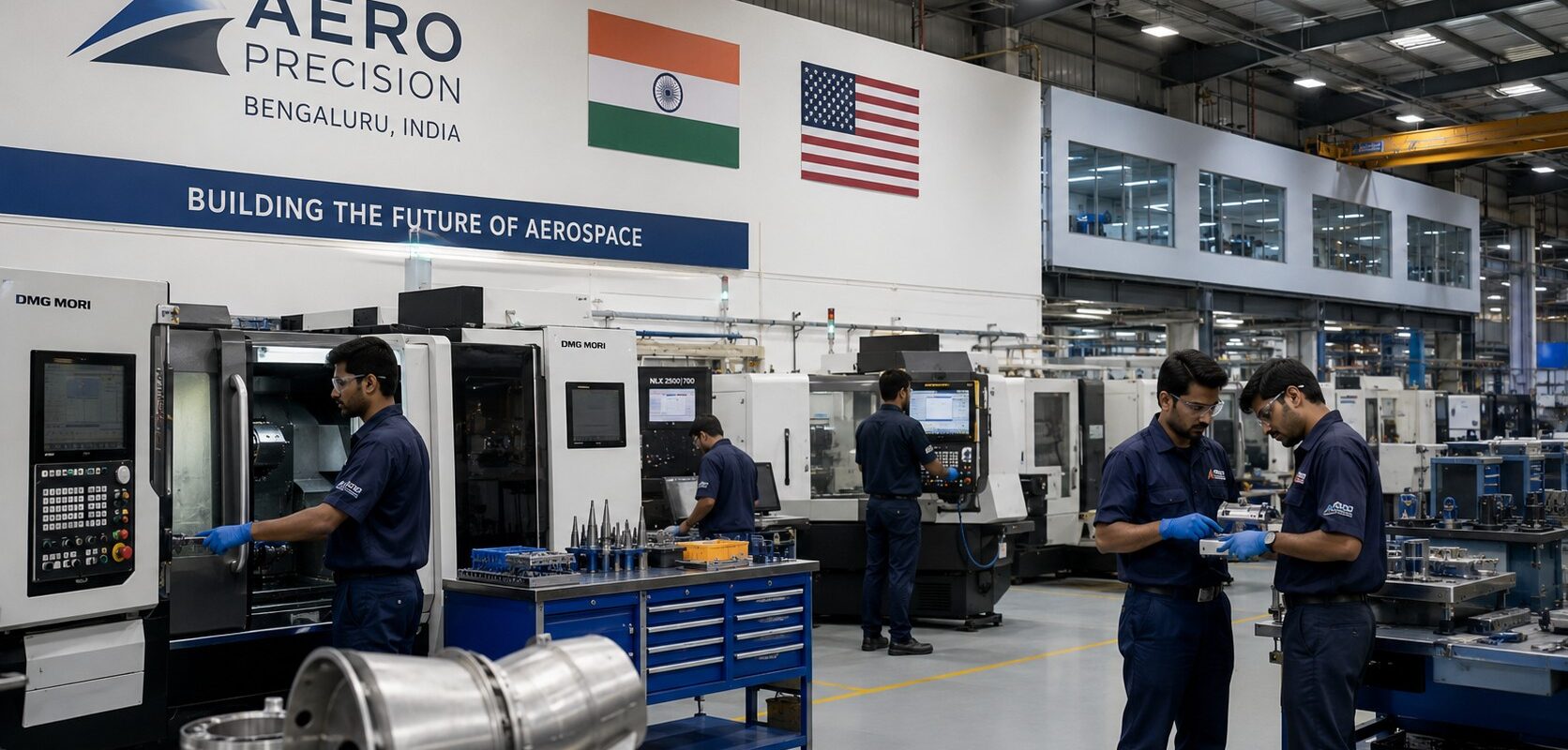
Not all aerospace manufacturing in India is equal. The city that consistently delivers for U.S. OEMs and Tier 1 suppliers is Bengaluru — and the reasons are structural, not incidental.
Anchor Institutions That Create the Talent Pipeline
- ISRO (Indian Space Research Organisation) — headquartered in Bengaluru, operates 6 major centers employing 17,000+ scientists and engineers
- HAL (Hindustan Aeronautics Limited) — manufactures military and civil aircraft, helicopters, and aero engines; the single largest aerospace employer in India
- NAL (National Aerospace Laboratories) — CSIR-operated research institution specializing in composites, aerodynamics, and structural testing
- GTRE (Gas Turbine Research Establishment) — develops jet propulsion systems under DRDO
- ADA (Aeronautical Development Agency) — designs combat aircraft including the Tejas fighter program
The Private Sector Layer
Bengaluru hosts over 250 aerospace companies in its private sector, including global captives for Airbus, Boeing, GE Aviation, Safran, Honeywell, and UTC Aerospace. This concentration means that the engineering and manufacturing talent pool is continuously trained to global standards — not to local approximations of them.
Infrastructure That Supports Production at Scale
- Aerospace SEZ (Special Economic Zone) at Devanahalli adjacent to Kempegowda International Airport
- Karnataka government’s Aerospace Policy providing land, infrastructure, and fiscal incentives to aerospace investors
- Direct air freight connectivity to U.S. hubs (Chicago O’Hare, JFK, LAX) for expedited part shipments
- 24/7 bonded warehouse facilities with customs fast-track lanes for aerospace components
Real Cost Savings: What the Numbers Actually Show
The 25-40% total operational cost reduction figure cited by companies engaged in aerospace manufacturing in India is not marketing language — it is validated by independent analysis. Here is how that number breaks down by cost category.
| Cost Category | U.S. Annual Cost | India Annual Cost | Savings % |
|---|---|---|---|
| Senior Mechanical Engineer | $95,000–$120,000 | $14,000–$18,000 | ~85% |
| CNC Machinist (5-axis) | $55,000–$75,000 | $7,000–$10,000 | ~87% |
| Quality Inspector (NADCAP) | $60,000–$80,000 | $8,000–$12,000 | ~85% |
| Manufacturing Facility (sq ft/yr) | $18–$35 | $3–$6 | ~83% |
| Employee Benefits & Taxes | 28–35% of salary | 12–15% of salary | ~55% |
Sources: Robert Half 2025 Salary Guide; IBEF Aerospace Sector Report 2025; Deloitte Global Manufacturing Cost Competitiveness Study 2024.
Where the Remaining Cost Goes — And Why That Is the Right Trade
The 60-75% savings on direct labor do not translate linearly to 60-75% total cost savings because additional line items appear: international logistics (3-6% of contract value), vendor qualification costs (one-time, amortized over contract life), management oversight, and quality audit travel. Net of all transition and ongoing management costs, consistently validated savings land in the 25-40% range on total program cost — not per-unit labor cost.
Use our ROI savings calculator to model your specific program against your current cost structure.
Quality Standards: NADCAP, AS9100D, and ITAR Compliance
The question most U.S. procurement directors ask first is not “how much does it cost?” It is “can they meet our quality requirements?” The answer, for Bengaluru’s mature aerospace manufacturing facilities, is yes — with independently audited evidence.
NADCAP Accreditation
NADCAP (National Aerospace and Defense Contractors Accreditation Program), managed by the Performance Review Institute (PRI), is the most rigorous third-party quality accreditation in aerospace manufacturing. Bengaluru now hosts NADCAP-accredited facilities in: chemical processing, heat treating, non-destructive testing (NDT), welding, and composites manufacturing. These accreditations are not self-declared — they require on-site audits by PRI-approved auditors and are renewable on 12-18 month cycles.
AS9100D Certification
AS9100D is the aerospace quality management system standard required by virtually every OEM prime contractor globally. Indian aerospace suppliers holding AS9100D certification are audited by IAQG-accredited certification bodies (Bureau Veritas, TÜV SÜD, DNV) — the same bodies that audit U.S. facilities for the same standard. Certification is not jurisdiction-specific.
ITAR and Export Control Compliance
International Traffic in Arms Regulations (ITAR) compliance is the most operationally complex element of India-sourced aerospace manufacturing. Key compliance structures include:
- Technical data transfer governed by ITAR exemptions or DSP-5 export licenses
- Controlled access IT environments (no foreign national access to ITAR-controlled files)
- U.S. Person technical oversight for ITAR-controlled programs
- Non-disclosure and technology control plan (TCP) agreements as standard contract provisions
- Engagement limited to ITAR-registered Indian facilities with demonstrated compliance history
We work exclusively with ITAR-registered facilities and provide structured compliance documentation as part of every engagement. See our compliance services overview for detail.
The 24/7 Production Advantage
The 10.5-hour time zone offset between U.S. Central time (Minnesota, Chicago, Dallas) and India Standard Time (IST) is frequently cited as a coordination challenge. In practice, for aerospace manufacturing, it is a production multiplier.
How the Follow-the-Sun Model Works in Practice
- 4:00 PM CST: U.S. engineering team submits revised drawing package with ECN (engineering change notice)
- 5:30 AM IST (next day): Bengaluru team receives, reviews, and flags questions before U.S. team arrives at their desks
- 8:00 AM CST: U.S. team arrives to find updated machining program, toolpath simulation, and first-article inspection report waiting in shared project management system
- Net result: A revision cycle that would take 24-48 hours domestically completes in 12-14 hours
For programs on critical-path delivery schedules, this compression of revision cycles is quantifiable. A program requiring 8 ECN cycles compresses from 16-32 days of domestic cycle time to 4-7 days with a Bengaluru team operating in parallel. That schedule compression translates directly to earlier delivery and reduced program risk.
India vs. Mexico vs. Eastern Europe: The Sourcing Comparison
Aerospace manufacturing in India competes against two primary alternative nearshoring and offshoring strategies for U.S. manufacturers: Mexico (nearshoring) and Eastern Europe (primarily Poland, Czech Republic, Romania). The comparison is not one-dimensional.
| Criteria | India (Bengaluru) | Mexico | Eastern Europe |
|---|---|---|---|
| Labor cost savings vs. U.S. | 70–88% | 40–55% | 45–65% |
| English proficiency | High (engineering workforce) | Variable | High (technical roles) |
| Aerospace ecosystem depth | Very High | Moderate | Moderate–High |
| NADCAP-accredited facilities | Yes | Yes (limited) | Yes |
| ITAR compliance infrastructure | Established (with counsel) | Established | Established |
| Time zone (vs. U.S. Central) | +10.5 hrs (follow-the-sun) | −1 to +2 hrs (real-time) | +6 to +8 hrs |
| Geopolitical risk (2026) | Low–Moderate | Moderate (tariff uncertainty) | Moderate (conflict proximity) |
| Talent pool scalability | Very High | Moderate | Moderate |
India’s primary advantage over Mexico in 2026 is tariff exposure. U.S.-Mexico trade operates under USMCA, but manufacturing inputs and re-export rules create complexity for aerospace components with multinational supply chains. India, operating under bilateral trade agreements and currently in active negotiation of a U.S.-India trade framework, presents a different tariff profile that procurement teams should model separately for each program.
How the Transition Works: 4 Phases to Full Production
The most common concern we hear from U.S. aerospace manufacturers evaluating India aerospace manufacturing is operational: “How do we actually make the transition without disrupting current production?” The answer is a structured 4-phase process with defined exit criteria at each gate.
Phase 1: Discovery and Supplier Qualification (Weeks 1–4)
- Technical package review (drawings, specifications, material requirements)
- Shortlist of qualified Bengaluru facilities against your AS9100D / NADCAP requirements
- Facility audit (virtual or on-site) with documented findings
- NDA, TCP, and ITAR compliance agreement execution
- Commercial term negotiation
Phase 2: Pilot Production Run (Weeks 5–10)
- First-article inspection (FAI) per AS9102 on all pilot parts
- Dimensional, material, and process certification documentation
- Side-by-side comparison with current supplier output
- Customer approval (if required by your OEM contract)
- Logistics trial: actual shipping, customs clearance, lead time validation
Phase 3: Parallel Production (Weeks 11–16)
- India supplier runs at 25-50% of target volume while current supplier continues
- Statistical process control (SPC) data collected and reviewed
- Communication protocols, escalation paths, and project management tools finalized
- Inventory buffer established to cover any transition-period variance
Phase 4: Full Production Handoff (Week 17+)
- Transition to India as primary or co-primary supplier
- Ongoing quarterly quality reviews with KPI dashboard
- Annual facility re-audit
- Continuous improvement program (kaizen cadence) with supplier
Ready to begin? Contact our sourcing team to start Phase 1 at no cost to you.
Risk Mitigation: IP Protection, Supply Chain Resilience, and Oversight
Sophisticated procurement teams evaluating aerospace manufacturing in India identify three risk categories that require active management: intellectual property protection, supply chain continuity, and quality oversight at distance.
Intellectual Property Protection
India is a signatory to the TRIPS Agreement (Trade-Related Aspects of Intellectual Property Rights) under the WTO, providing a legal framework for IP enforcement equivalent to international standards. Contractual protections employed in our engagements include:
- Comprehensive NDA with liquidated damages provisions under both U.S. and Indian law
- Technology Control Plan limiting data access to named individuals with background verification
- Drawing watermarking and version control with digital audit trails
- No-compete provisions on manufacturing process know-how for defined periods
Supply Chain Continuity
Single-source dependency is the risk, not geography. Best practice for India sourcing mirrors best practice for any supply chain: dual qualification of critical suppliers, safety stock protocols for long-lead raw materials (titanium, Inconel, specialty alloys), and contractual production capacity reservation. For critical programs, we recommend maintaining qualified backup capacity — which can be a second India facility or a domestic fallback — for parts with lead times under 30 days.
Quality Oversight at Distance
Physical distance does not reduce quality visibility when the infrastructure is correct. Our clients use:
- Real-time shared quality management systems (ETQ, Greenlight Guru, or customer-specified platforms)
- In-country quality representative (resident or periodic) at supplier facility
- CMM data and inspection images transmitted with every shipment
- Quarterly on-site audits with U.S.-side participation (in-person or video-linked)
Real Results: U.S. Manufacturers Already Making the Move
The following represent anonymized program outcomes from engagements where U.S. aerospace manufacturers transitioned work to Bengaluru-based facilities. Full case studies are available at our case studies library.
Case Study A: Precision Machined Structural Components
A Tier 2 supplier to a major commercial airframe OEM transitioned CNC machining of aluminum structural brackets (50 part numbers, 1,200 units/quarter) to a Bengaluru facility. Outcome after 12 months: 31% reduction in total program cost, zero customer escapes, first-pass yield improvement from 94.2% to 97.8%, and lead time reduction from 14 weeks to 9 weeks due to dedicated capacity reservation.
Case Study B: Avionics Enclosure Manufacturing
A defense electronics manufacturer sourced sheet metal avionics enclosures and chassis from a Bengaluru AS9100D/ NADCAP facility. Outcome: 38% cost reduction versus incumbent U.S. supplier, successful DCSA facility security clearance equivalent established for controlled technical data, and expansion from 3 part numbers to 27 part numbers over 18 months.
Case Study C: Engineering Design Services
A U.S. aircraft MRO company engaged a Bengaluru engineering team for structural repair design (SRM-compliant repair schemes, DTA analysis support). Outcome: 72-hour turnaround on repair design packages that previously required 8-10 business days domestically, 84% reduction in engineering cost-per-repair-package, enabling the MRO to price competitively on contracts previously declined due to engineering cost.
Frequently Asked Questions About Aerospace Manufacturing in India
Is aerospace manufacturing in India NADCAP and AS9100D certified?
Yes. Leading aerospace manufacturing facilities in Bengaluru hold NADCAP accreditation and AS9100D certification. These are the same quality standards required by Boeing, Airbus, and Lockheed Martin globally. Facilities are subject to regular third-party audits to maintain certification.
How does India aerospace manufacturing handle ITAR compliance?
ITAR-controlled data and technical packages are managed through controlled access environments with U.S. Person oversight protocols. Structuring engagements correctly — with legal counsel familiar with both U.S. export regulations and Indian FDI rules — ensures full compliance. We work with ITAR-registered facilities only.
What cost savings can U.S. aerospace companies expect from India sourcing?
U.S. aerospace manufacturers typically achieve 25-40% reduction in total operational costs through India sourcing. Engineering labor savings alone can reach 70-88% compared to equivalent U.S. roles, with equivalent or superior output quality from NADCAP-certified teams.
How long does it take to transition aerospace manufacturing work to India?
A structured transition typically takes 60-120 days depending on part complexity, documentation readiness, and required certifications. Our onboarding process includes a discovery phase, pilot production run, quality validation, and full production handoff.
What types of aerospace components are manufactured in India?
Indian aerospace manufacturers produce structural airframe components, precision machined parts, avionics enclosures, hydraulic system components, composite structures, electrical harnesses, and MRO services. Bengaluru facilities serve commercial aviation, defense, and space sectors.
The Strategic Decision Is Now
Aerospace manufacturing in India is no longer an experimental strategy — it is the operating model of manufacturers who will lead their categories through 2030. The combination of a mature, NADCAP-certified supplier ecosystem in Bengaluru, validated 25-40% cost reductions, and a talent pipeline deeper than any comparable geography makes India the structurally superior choice for U.S. manufacturers willing to execute the transition systematically.
The manufacturers who engage now establish the supplier relationships, the quality systems, and the institutional knowledge that create durable competitive advantage. Those who wait face the same cost pressures but without the runway to transition methodically.
Start Your Aerospace Sourcing Assessment
Our sourcing team will analyze your current cost structure, identify the highest-impact part families for India transition, and model your specific ROI — at no cost. Most manufacturers identify $500K-$2M in annual savings potential within the first assessment.