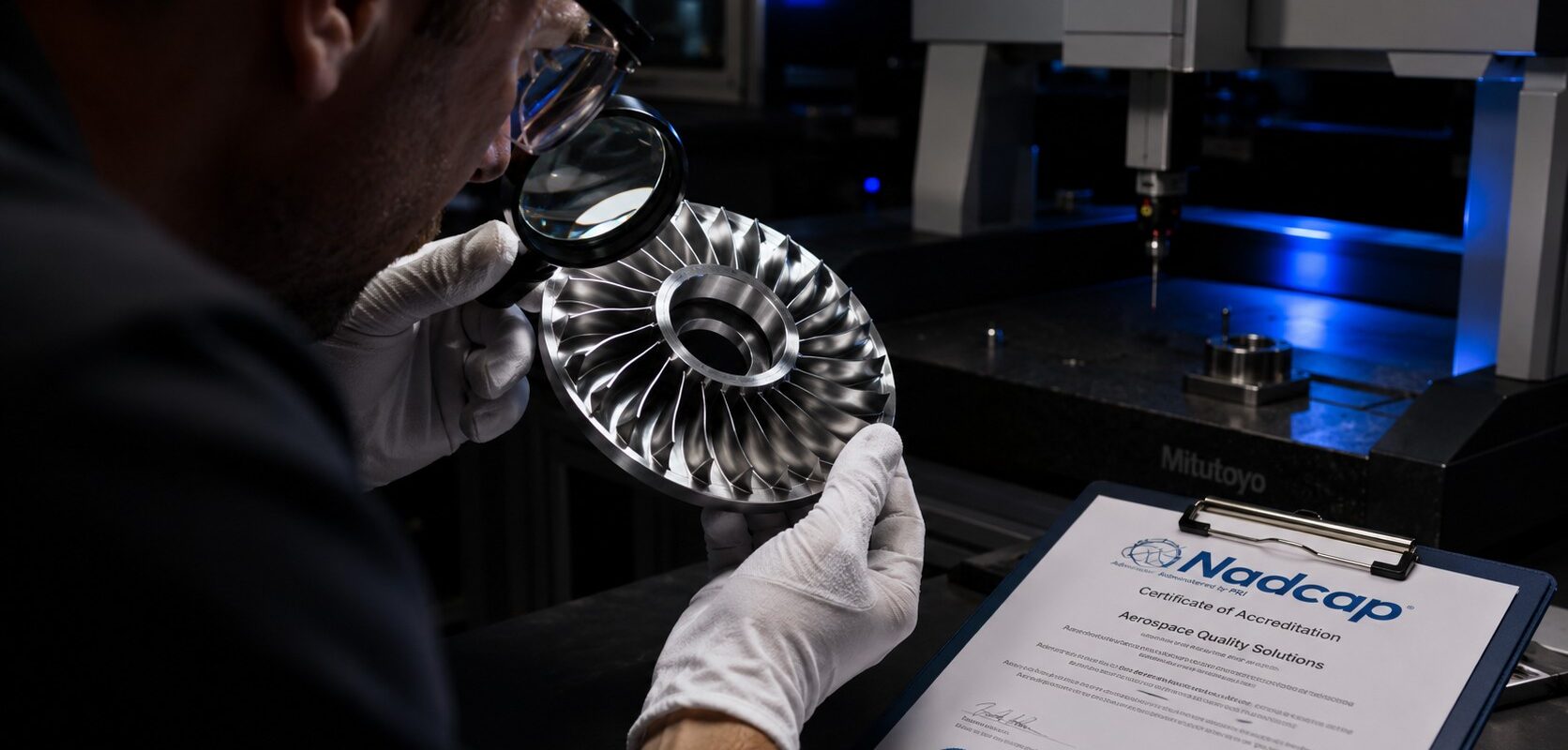
Understanding NADCAP Certification in Aerospace Manufacturing
NADCAP certification aerospace is the single most important quality credential a special process supplier can hold in the global aerospace supply chain. Whether you are a U.S. prime contractor, a Tier 1 supplier, or an OEM procurement team evaluating Indian manufacturing partners, a facility’s NADCAP accreditation status is a non-negotiable qualification gate — not a preference.
This guide explains exactly what NADCAP certification covers, how the audit process works, why major aerospace companies require it, what it takes for a facility to maintain accreditation, and how LCCSGI enforces NADCAP compliance across its partner network in India.
What Is NADCAP? The Program Explained
NADCAP stands for National Aerospace and Defense Contractors Accreditation Program. It was established in 1990 by the Performance Review Institute (PRI), a not-for-profit organization that administers the program on behalf of its member companies — the world’s largest aerospace and defense OEMs.
Before NADCAP, each major OEM conducted its own supplier audits for special processes, creating a fragmented landscape in which a single supplier might undergo dozens of redundant audits annually from different customers. NADCAP replaced this inefficiency with a single, industry-agreed audit standard. One NADCAP audit satisfies the special process qualification requirements of all subscribing primes simultaneously.
The program operates through commodity-specific task groups — cross-functional teams of engineers from member companies who develop and continuously update the audit checklists (called Job Audits) for each process category. This structure ensures that NADCAP requirements reflect current engineering and safety standards, not a static document last revised a decade ago.
Who Manages NADCAP?
PRI is headquartered in Pittsburgh, Pennsylvania, and manages NADCAP through a network of accredited third-party auditors. These auditors are technically qualified specialists — not generalist quality consultants — who are themselves approved and monitored by PRI for each commodity they audit. This creates a two-layer accountability structure: the auditor is qualified for the specific process, and PRI oversees auditor performance.
Which Special Processes Does NADCAP Certification Cover?
NADCAP accreditation is commodity-specific, meaning a facility is accredited separately for each special process it performs. A facility that welds and heat treats must hold NADCAP certification for both commodities independently. The major NADCAP commodity areas are:
| NADCAP Commodity | Typical Applications in Aerospace | Key Standards Referenced |
|---|---|---|
| Heat Treating | Landing gear components, structural fasteners, turbine discs | AMS 2750, AMS 2770, AMS 2759 series |
| Chemical Processing | Anodizing, conversion coatings, etching, pickling, cleaning | AMS 2470, AMS 2471, AMS 2474, AMS 2480 |
| Welding | Structural assemblies, engine brackets, fuel system components | AWS D1.2, AWS D17.1, AMS 2680 |
| Non-Destructive Testing (NDT) | Inspection of all critical flight hardware | NAS 410, EN 4179, ASTM E series |
| Coatings | Thermal spray, HVOF, painting, plating | AMS 2400, AMS 2404, AMS 2430 |
| Composites | Aerostructures, radomes, interior panels | OEM-specific process specifications |
| Electrical Discharge Machining (EDM) | Turbine blade cooling holes, complex geometry cutouts | OEM process specifications |
| Fluid Distribution Systems | Hydraulic lines, fuel lines, pneumatic tubing | AS1055, MIL-H series |
| Materials Testing Laboratories | Mechanical testing, chemical analysis, metallographic examination | ISO 17025, ASTM standards |
| Sealants | Fuel tank sealing, pressurized section assembly | AMS-S-8802, BMS 5-95 |
| Shot Peening | Fatigue-life improvement on landing gear and engine components | AMS 2430, SAE J2441 |
Each commodity area has its own audit checklist developed by industry task groups. The checklists are not generic quality management questions — they are technically specific and process-oriented, interrogating actual process parameters, equipment calibration records, operator qualification logs, and real-time production traceability.
How the NADCAP Certification Process Works
Achieving NADCAP certification aerospace accreditation is a structured, multi-stage process. A facility cannot simply apply and receive a certificate. The pathway requires documented preparation, a technical on-site audit, findings resolution, and ongoing surveillance.
Stage 1: Subscriber Nomination and Application
A supplier typically begins the NADCAP process when a subscribing prime contractor nominates them or when the supplier proactively applies through the eAuditNet portal (PRI’s online audit management platform). The supplier selects the commodity areas for which they are seeking accreditation and submits pre-audit documentation including current quality manual, process specifications in use, equipment list, and personnel qualification records.
Stage 2: Pre-Audit Self-Assessment
PRI provides suppliers access to the relevant Job Audit checklist. Facilities are expected to conduct a rigorous internal self-assessment against every checklist item before the on-site audit. This step is critical: facilities that skip self-assessment frequently discover non-compliances during the actual audit that could have been corrected in advance, increasing both audit risk and cost.
Stage 3: On-Site Audit
A PRI-approved auditor, qualified specifically for the commodity being evaluated, conducts the on-site audit. For a single commodity, the audit typically runs two to three days. Multi-commodity audits can extend to five or more days. The auditor evaluates:
- Process documentation and control plans against the applicable specifications
- Equipment calibration, maintenance records, and Survey data (for heat treating, pyrometry systems per AMS 2750)
- Operator qualification and training records
- In-process control records and traveler traceability
- Non-conformance and corrective action history
- Live process witnessing — the auditor observes actual production, not just paperwork
- Customer specification compliance for active jobs in production
Stage 4: Findings and Corrective Action
Non-conformances identified during the audit are classified as either Minor or Major findings. All findings must be formally closed before accreditation is granted. The supplier submits a Corrective Action Plan (CAP) for each finding through eAuditNet, and PRI-appointed staff review the adequacy of root cause analysis and corrective actions before accepting closure.
Stage 5: Accreditation Decision
Once all findings are closed to PRI’s satisfaction, the Supplier Performance Committee (SPOC) — a standing committee of member company representatives — reviews the audit outcome and issues the accreditation decision. Accreditation is not issued by the auditor but by the committee of OEM engineers, preserving the integrity of the process.
Stage 6: Accreditation Period and Merit Status
New accreditations are typically valid for 12 months. Suppliers who demonstrate consistent compliance over successive audits can qualify for an 18-month or 24-month accreditation interval. The highest recognition, NADCAP Merit Status, is awarded to suppliers who achieve a flawless audit record over multiple cycles, reflecting sustained process excellence.
NADCAP vs. AS9100: Understanding the Difference
A common question in aerospace procurement is whether AS9100 certification is sufficient and NADCAP is redundant. It is not. The two standards are complementary and address fundamentally different scopes.
| Dimension | AS9100 | NADCAP |
|---|---|---|
| Scope | Quality management system — how the organization manages quality across all operations | Specific special processes — how a specific technical process is performed |
| Audit Focus | Management systems, documentation, continuous improvement | Technical process parameters, equipment, operator qualification, live production |
| Issued By | IAQG-accredited certification bodies | Performance Review Institute (PRI), on behalf of OEM member companies |
| Frequency | 3-year certification cycle with annual surveillance audits | 12 to 24 months depending on performance, with no fixed cycle discount |
| Required For | General aerospace supply chain participation | Performing special processes on flight hardware for most primes |
For flight-critical components, most Tier 1 and prime contractors require both certifications. An AS9100-certified facility that is not NADCAP-accredited cannot legally perform heat treating or chemical processing on Boeing or Airbus flight hardware under most flow-down requirements.
Why NADCAP Certification Aerospace Matters for India Sourcing
India has become one of the fastest-growing aerospace manufacturing destinations globally. The combination of a large engineering talent base, competitive manufacturing costs, and significant government investment through initiatives such as Make in India and the Aerospace and Defence Manufacturing Policy has positioned Indian facilities — particularly in Bengaluru, Hyderabad, and Pune — as serious participants in global aerospace supply chains.
However, the quality credential question is always the first one U.S. and European OEMs ask. NADCAP certification aerospace accreditation is the most efficient answer to that question because it removes subjectivity entirely: a facility either holds a current, valid NADCAP accreditation from PRI for the relevant commodity, or it does not.
Risks of Sourcing from Non-NADCAP Facilities
Procuring special process work from a non-accredited facility — even if that facility claims equivalent capability — creates significant supply chain risk:
- Customer flow-down violation: Most prime and Tier 1 purchase orders explicitly flow down NADCAP requirements. Sourcing from a non-accredited facility places the buyer in contractual non-compliance.
- Escapes and recalls: Special processes such as heat treating and NDT are invisible to visual inspection. A process deficiency may not surface until a component fails in service, creating potentially catastrophic liability.
- Re-qualification costs: If a non-accredited supplier is later discovered, all components produced under that contract may require disposition, re-testing, or scrapping — at the buyer’s cost.
- Audit findings: During customer audits of your own facility, non-NADCAP special process sourcing is a guaranteed finding that can jeopardize your own accreditation status.
The India NADCAP Landscape
India’s aerospace manufacturing cluster in Bengaluru hosts facilities holding NADCAP accreditation across heat treating, chemical processing, NDT, and welding. Companies supplying to HAL, DRDO, and global Tier 1s have invested substantially in NADCAP accreditation as a prerequisite for access to export markets. This investment represents a real quality differentiator that separates credentialed Indian facilities from the broader manufacturing market.
The challenge for U.S. procurement teams is not whether NADCAP-accredited facilities exist in India — they do — but in reliably identifying, verifying, and monitoring them without in-country presence. That is the problem LCCSGI solves.
How LCCSGI Enforces NADCAP Certification Across Its Partner Network
LCCSGI operates a structured, multi-layer quality enforcement model that is specifically designed around the requirements of U.S. aerospace OEMs and their special process compliance obligations. NADCAP certification aerospace accreditation verification is embedded at every stage of the engagement.
Supplier Qualification
Every facility in the LCCSGI partner network undergoes a comprehensive qualification process before being approved for production engagement. This includes:
- Direct verification of current NADCAP accreditation through the PRI eAuditNet public database — not reliance on a supplier-provided certificate copy, which may be outdated or misrepresent scope
- On-site technical assessment of process capability, equipment calibration status, and quality management system maturity
- Review of customer audit history, including any Major findings and corrective action closure records
- Operator qualification verification for each NADCAP commodity relevant to the scope of work
- Flow-down compliance review to confirm the facility’s purchase order control procedures correctly flow NADCAP requirements to their sub-tier suppliers
Active Production Monitoring
Supplier qualification is a point-in-time assessment. LCCSGI’s model adds continuous monitoring to ensure that the conditions verified during qualification remain in place throughout production. This includes:
- Pre-production kick-off reviews confirming NADCAP accreditation status, process specification revision levels, and first article requirements
- In-process monitoring visits aligned to critical process steps, particularly for long-lead or high-criticality components
- Real-time accreditation surveillance — NADCAP certificates expire, and accreditation can be suspended or revoked between audit cycles if a facility receives a non-compliance notification from PRI. LCCSGI monitors partner facilities for any change in accreditation status throughout the contract period
Pre-Dispatch Inspection (PDI)
Before any component leaves the facility and enters the export documentation process, LCCSGI conducts a structured Pre-Dispatch Inspection. PDI for special process components specifically verifies:
- Presence and completeness of special process certifications and test reports in the shipment documentation package
- Traceability of material through the special process — lot numbers, process dates, operator identification, and equipment identification where required
- Dimensional and visual conformance against the applicable drawing
- Compliance with customer-specified packaging and preservation requirements for components that have undergone surface treatment or coating
CAPA and Continuous Improvement
Non-conformances found during PDI or reported by the customer trigger a formal CAPA (Corrective Action and Preventive Action) process with the facility. LCCSGI manages the CAPA loop on behalf of the U.S. customer, translating findings into actionable corrective measures, verifying root cause analysis adequacy, and confirming objective evidence of corrective action effectiveness before closing the loop.
For more detail on how our end-to-end process is structured, see How Our Quality-Controlled Sourcing Process Works. To review specific customer outcomes, visit our Case Studies.
NADCAP Certification Audit Checklist: What Facilities Are Evaluated On
While full NADCAP audit checklists are proprietary to PRI and available only through the eAuditNet platform, the categories of evaluation are consistent across commodities. Understanding these areas helps procurement teams ask better questions when qualifying suppliers directly.
- Process documentation control: Are current, approved revisions of all process specifications accessible at the point of use? Are superseded documents removed from production areas?
- Equipment qualification and calibration: Is all process-critical equipment qualified, calibrated on schedule, and operating within the defined parameters? For heat treating, this includes pyrometry system surveys per AMS 2750.
- Personnel qualification: Are all operators and inspectors trained and qualified to the specific process requirements? Are qualification records current and traceable?
- Process parameter control: Are in-process parameters (temperature, time, concentration, current density, etc.) recorded in real time and retained as quality records?
- Sub-tier control: Does the facility flow NADCAP requirements to its own suppliers where applicable, and does it verify their compliance?
- Non-conformance management: Is there a functioning system for identifying, segregating, dispositioning, and recording non-conforming product?
- Customer specification compliance: Are customer engineering requirements — including specific OEM process specifications — incorporated into production planning and verified in execution?
Frequently Asked Questions About NADCAP Certification Aerospace
What does NADCAP certification cover in aerospace manufacturing?
NADCAP certification covers special processes including heat treating, chemical processing, welding, non-destructive testing, composites, coatings, electrical discharge machining, fluid distribution systems, materials testing laboratories, sealants, and shot peening. Each commodity has its own audit criteria and is accredited independently.
How long does a NADCAP audit take?
A NADCAP audit typically takes two to five days on-site depending on the commodity area and facility complexity. Pre-audit preparation — including self-assessment and documentation review — can take several weeks. The full accreditation cycle from application to certificate, including findings closure, commonly takes three to six months for first-time applicants.
How often must NADCAP certification be renewed?
NADCAP accreditation is issued for 12 months for new entrants, extending to 18 or 24 months for suppliers with a consistent compliance record. Merit status, which provides the longest accreditation interval and reduced audit frequency, is awarded to suppliers who demonstrate sustained excellence across multiple audit cycles.
Is NADCAP certification required to supply Boeing or Airbus?
Yes. Boeing, Airbus, Lockheed Martin, Raytheon Technologies, GE Aviation, Rolls-Royce, Safran, and most other Tier 1 aerospace OEMs require NADCAP accreditation for suppliers performing special processes on flight-critical components. The requirement is typically flowed down through purchase order quality clauses and supplier qualification procedures.
Do Indian aerospace manufacturers hold NADCAP certification?
Yes. A growing number of Indian aerospace manufacturers — particularly in Bengaluru, Hyderabad, and Pune — hold NADCAP accreditation for heat treating, chemical processing, NDT, welding, and other commodity areas. LCCSGI works exclusively with accredited facilities and independently verifies accreditation status through the PRI eAuditNet database before each production engagement.
What is the difference between AS9100 and NADCAP?
AS9100 is a quality management system standard governing how an organization manages quality across all operations. NADCAP is a process-specific accreditation confirming that a particular special process is executed to precise technical standards. Most aerospace primes require both, and they are not substitutes for each other.
What happens if a supplier loses NADCAP accreditation during an active contract?
Loss of NADCAP accreditation during an active production contract is a serious supply chain event. Depending on the customer’s quality clause language, it may trigger a stop-work requirement, mandatory notification to the prime, and potential re-qualification of all product produced after the accreditation lapse. LCCSGI’s continuous accreditation monitoring is designed to detect any change in accreditation status before it affects production.
Working With LCCSGI: NADCAP-Verified Aerospace Sourcing from India
LCCSGI’s value proposition for U.S. aerospace OEMs and Tier 1 suppliers is direct: we provide access to India’s most capable aerospace manufacturing facilities, with independent NADCAP certification verification and active quality surveillance embedded in every engagement. You get the cost and lead time advantages of Indian manufacturing without assuming the quality risk of sourcing without in-country expertise.
Our team includes quality engineers with direct aerospace supply chain and special process compliance experience. We do not simply pass supplier certifications through to you — we independently verify them, monitor them in real time, and stand behind every shipment with documented quality evidence.
If you are evaluating Indian aerospace sourcing and need to confirm that the facilities you are considering hold valid NADCAP accreditation, or if you have an active supply chain gap that requires a qualified, accredited Indian partner, we can help.